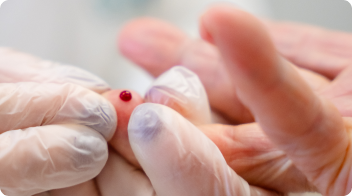
Hemospec brings multi-parameter blood analysis closer to the point of care. Its value becomes clearer when seen in the settings where speed, accessibility and workflow matter most. Across different clinical environments, the Hemospec role changes — from first-line assessment to perioperative follow-up, from community-based screening to decentralized care. What remains consistent is the ability to bring structured blood insight closer to the moment of care.
Primary care often sits at the point where symptoms are still unspecific and the next decision matters most. The challenge is not only to assess the patient, but to decide what can remain in the community, what needs follow-up, and what should move to another level of care.
In this setting, one of the clearest applications of Hemospec is CRP for antibiotic management. CRP can support the clinical assessment of respiratory and other acute presentations, helping frame when the picture is more compatible with self-limiting infection and when closer follow-up, escalation or antibiotic treatment deserves stronger consideration.
In primary care, the system helps make the consultation more informed, more complete and more decisive.

First-line assessment of symptomatic patients
Follow-up where anemia or inflammatory change matters
Referral decisions supported
by blood-based information closer to the consultation
A more complete view when hemoglobin and CRP are both clinically relevant
Community pharmacies are often the first point of contact. Patients arrive early in the course of symptoms and expect a service that is quick, clear and easy to access. That makes simplicity and speed essential.
Here, CRP expands the role of the system significantly. It allows pharmacies to move beyond anemia-only screening and support first-contact assessment in acute situations, especially where the immediate question is whether the patient can remain in community-based care or should be referred more quickly.
Community-based
screening
First-contact assessment in symptomatic patients
More informed
referral decisions
A practical workflow that fits a patient-facing environment
Perioperative pathways depend on timing. Before and after a procedure, clinicians often need a clearer picture of blood loss, recovery status and inflammatory change in order to decide what happens next.
In this setting, Hemospec is relevant because it brings blood analysis closer to the perioperative workflow. Hemoglobin and the erythrocyte panel can add visibility around bleeding and anemia, while CRP adds another layer of value by helping frame inflammation and possible post-operative complication patterns.
Pre-procedure baseline
assessment
Post-procedure visibility around blood loss and anemia
Inflammatory follow-up in the immediate recovery period
Support for discharge,
re-evaluation or escalation decisions
Senior care settings such as ERPIs, home support services and day centres face a different kind of challenge. Clinical need is often combined with mobility constraints, fragile populations and routines that do not fit easily with conventional testing pathways.
In this context, the strongest role for Hemospec is decentralised access to blood analysis in a format that is easier to bring to the person. The value lies in portability, simplicity and repeatability. The most natural fit is not continuous individual monitoring, but screening, repeated access and prevalence-oriented routines that match these environments more closely.
Screening in older or fragile populations
Easier repeated access where transport and mobility are barriers
Assessment closer to the resident or user
Support for practical decentralized care routines
For product architecture, software and system components, see Hemospec.
For clinical studies, certification pathway and performance data, see Scientific Validation.