Near-infrared spectroscopy, applied
to whole blood
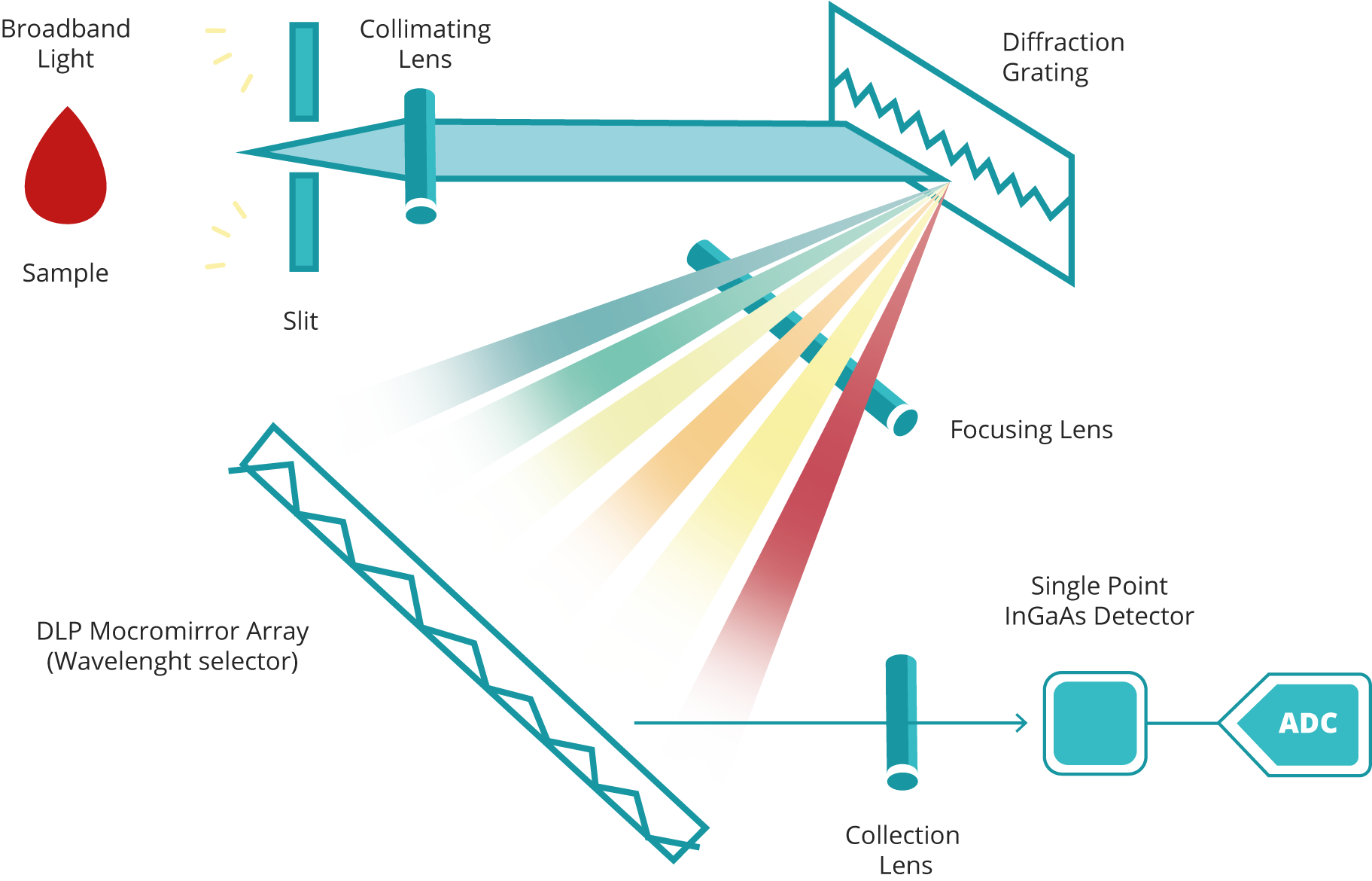
Hemospec uses near-infrared spectroscopy (NIR) to analyse whole blood through its optical signature. The system measures how the sample absorbs light across the near-infrared region. That spectral signal carries information related to the molecular composition of the sample and can be used to estimate clinically relevant parameters.
In practice, the sensor captures the optical reading, and the analytical layer processes that signal using cloud-based models. The aim is to extract useful information from the spectral pattern of the sample and translate it into a structured result set. This is why the system combines photonics, software and analytical modelling in a single architecture.
Why?
This approach makes it possible to work with a small blood sample, avoid reagent-heavy handling and bring a broader panel of biomarkers closer to the point of care. In the current product framing, that includes hematological parameters together with C-reactive protein, expanding the system beyond single-analyte testing.
Validation and performance
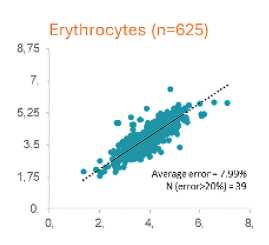
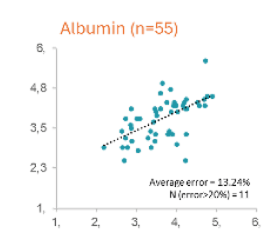
The current validation work shows stronger consistency in the hematological panel, supported by larger sample sets and more stable distributions, while some biochemical parameters still show greater variability and require more cautious interpretation. That distinction is important and should be explicit on the page.
Performance Profile
Hematocrit
MARD around 9%, with accuracy ranging from 84% to 87%
Hemoglobin
MARD around 8–10%, with accuracy ranging from 82% to 94%
RBC
MARD around 10–11%, with accuracy ranging from 76% to 80%
CRP
Classification accuracy around 73% to 80% in validated units
RDW
MARD around 10–13%, with accuracy ranging from 61% to 63%
Hematocrit
MARD around 9%, with
accuracy ranging from 84% to
87%
Hemoglobin
MARD around 8–10%, with
accuracy ranging from 82% to
94%
RBC
MARD around 10–11%, with
accuracy ranging from 76%
to 80%
CRP
Classification accuracy around
73% to 80% in validated units
RDW
MARD around 10–13%, with
accuracy ranging from 61% to
63%
Studies
Texto sobre os papers e estudos no Hospital de Braga (Study 01 – MyHEALTH Do IT e Study 02 – Internal Medicine Department of Hospital de Braga)
Certifications
Ongoing and research
An expanding analytical platform
Hemospec continues to evolve as an analytical platform. Current work includes the expansion of the biomarker panel through targeted VIS/ NIR development in creatinine, total proteins, albumin, and additional work around glucose and lactate.
Glucose Non-invasive measurement
Labinlight is advancing non-invasive glucose measurement through transdermal optical analysis, combining dedicated optical configurations with analytical models developed for this new mode of sensing.
Non-targeted analysis
A second research direction is non-targeted analysis, where the full spectral signature is used to identify clinically meaningful patterns rather than focusing on a single biomarker alone. This approach opens the platform to broader analytical models associated with complex conditions, including sepsis, chronic kidney disease, iron-deficiency anaemia and prognostic stratification. Internal research materials already describe encouraging model performance across several of these exploratory paths.